A Personal Plan That Can Survive a Crowded Tuesday
A flexible personal plan helps you protect a meaningful aim, adjust the details and choose a clear review point when ordinary commitments disrupt your week.
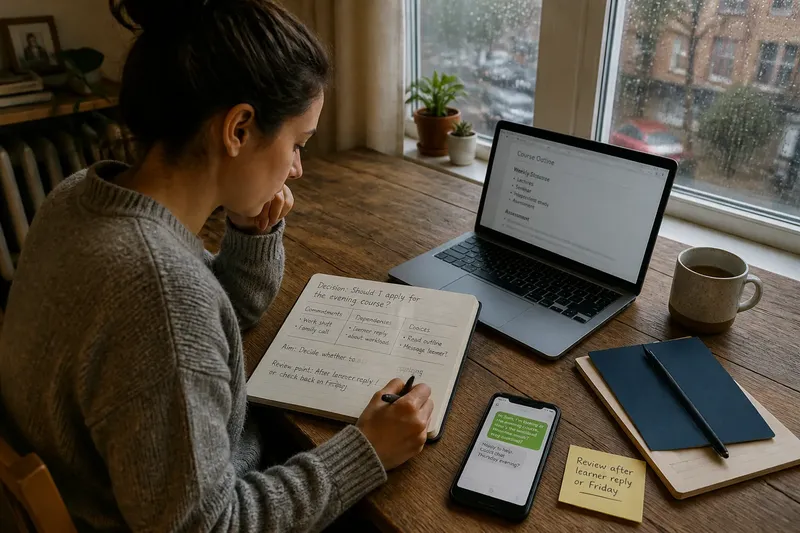
You set aside Tuesday evening to compare course outlines, but a family call and an unexpected work task take the time. A flexible personal plan can still help: it records what you meant to learn, what you can do next and how you will decide whether the plan still fits.
The planning challenge is not simply to allow for interruptions. It is to make the plan useful for decisions: which commitments deserve protection, which actions depend on other people, and what would make you change direction. That calls for more than a movable calendar entry.
Plan around decisions
Start with the decision your plan is meant to support. If you are considering a course, the decision might be whether to apply, ask for more information or leave the option aside. Then list only the actions that could inform that decision.
Separate those actions into three kinds:
- Commitments: fixed events or responsibilities that need a place in your calendar.
- Dependencies: actions that require a reply, permission or another person’s availability.
- Choices: actions you can schedule, replace or drop without affecting someone else.
This distinction changes how you handle a delay. A postponed conversation may require a new date; a reading task may move to a quieter day; a decision that depends on missing information may need to wait.
Write the decision beside the plan. It gives each task a reason to be there.
Build a personal plan
A personal plan works best when it shows what is settled and what remains open. Keep the aim in view, but do not turn every possible future action into a current obligation.
For each current action, record:
- Purpose: what you hope the action will help you decide or understand.
- Next move: a specific action you can take, such as reading a course outline or requesting a conversation.
- Constraint: a real limit, such as a work shift or the need for someone else’s reply.
- Alternative: another action that serves the same purpose if the first is unavailable.
- Review point: the event or new information that will prompt a decision.
Make each item lead to a choice. If a conversation is unavailable, decide whether an email could answer the same question or whether the plan should wait for a reply. If a task has no clear purpose, remove it until you know what decision it supports.
Choose a response
Different disruptions call for different planning decisions. Treating every obstacle as a scheduling problem can hide the real issue.
When commitments crowd the week
Keep fixed responsibilities in the calendar, then move or remove optional tasks rather than stacking missed work onto the next open evening. If the pressure is temporary, preserve the decision you are working towards and choose a later point to resume.
When information is missing
Do not fill a plan with dependent tasks before the information arrives. Record who you need to hear from, what you will do if the reply comes, and what alternative is available if it does not. This prevents waiting from looking like a failure to act.
When an aim feels imposed
A more detailed schedule will not resolve a mismatch between a goal and your own priorities. Ask whether you still want the outcome, or whether you are continuing from habit or pressure. If you pause, note what question remains and when you will reconsider it.
Review the plan when?
When should you review a personal plan?
Choose a review point linked to the decision, such as after a conversation or once a reply arrives. If no event is likely to settle the question, set a deliberate time to decide what information is still missing and whether to continue.
What belongs in a calendar?
Use a calendar for appointments, deadlines and commitments that depend on a particular time. Keep movable tasks in a short list or note, so a change to one evening does not make the whole plan look overdue.
What if someone does not reply?
Decide in advance whether a polite follow-up, a different contact or waiting is appropriate. If none would answer your question, mark the plan as dependent on that reply and choose another useful action that does not rely on it.
How do you know whether to pause?
Pause when continuing would require information, capacity or agreement that you do not currently have. Record the reason and the condition for returning; if the aim no longer matters to you, consider setting it aside rather than preserving it by default.
Work through a change
Say you are considering an evening course and have these starting inputs: an outline to read, one learner you can ask about the workload, and a work shift that may change. The decision is whether to ask about applying, not whether to enrol immediately.
First, you read the outline and note two questions about the weekly structure. Next, you message the learner with those questions. When the shift changes, you move the conversation to a time they can manage rather than adding it to a crowded evening. You keep the course decision open until the learner replies.
If the reply describes a workload that fits your current commitments, your next decision is whether to check the application requirements. If the reply leaves the main question unanswered, you ask one focused follow-up or look for another source of course information. If no useful information is available, you pause the application decision rather than pretending the outline settled it.
The result is a plan that distinguishes what you know from what you are still waiting to learn. Each change has a reason, and the next action depends on the answer rather than on the original timetable.
Use a decision check
At a review, check the observation first and choose the response that follows. This keeps revision tied to circumstances rather than a vague feeling that the plan should be rewritten.
- Observation: A fixed responsibility now occupies the planned time. If the task can move without affecting anyone else, reschedule it; then keep the aim active. If no workable time is available, pause the task and set a review point.
- Observation: A person has not replied. If a follow-up is appropriate, send one clear question; otherwise choose an alternative source or leave the dependent decision open.
- Observation: The available information answers the main question. If it supports the next decision, take that action; if it does not, identify the missing information before committing further.
- Observation: The aim still matters, but the current action feels too large. If a smaller action would answer the same question, use it; otherwise pause until you can identify a useful first move.
- Observation: The aim no longer reflects what you want. If another direction matters more, revise the plan around it; if you are unsure, pause and name the question you need to consider.
- Observation: A fallback would create a new obligation without answering the original question. If it still serves the plan’s purpose, use it; otherwise drop it rather than adding busywork.
A flexible personal plan is not an unfinished schedule. It is a record of the decision at hand, the evidence or conversation needed next, and the conditions that would change your choice. Put those details beside the next action, so a crowded Tuesday prompts a sensible decision instead of a verdict on the whole plan.