Before the Vision Board, Put Your Future into Words
Before the vision board, put your future into words to clarify what matters, then choose images that express more than a polished picture.
You open a fresh notebook, write “a better future”, and pause. Before making a vision board, put your future into words: a sentence can name a reason, a condition or a question that a picture may leave unclear.
Start with the part you can describe, not a complete picture of where your life should lead. A few plain words can help you decide which images belong and which merely look appealing.
Words name the meaning
Writing makes it easier to distinguish an activity from the quality you want it to bring. “I want to travel” describes an activity. “I want work that leaves space for unfamiliar places and unhurried mornings” names qualities that might fit more than one kind of life.
Words also let you record what is unsettled. You might write, “I might want to teach,” or, “I miss making things, but I do not know what that means yet.” Such phrases show what you are considering without dressing a question up as a decision.
Describe an ordinary scene rather than an impressive achievement. Note who is there, what occupies your attention and what you wish had less room. Specific details can help separate a genuine preference from a broad ideal.
Write a rough sentence before searching for pictures.
Images add atmosphere
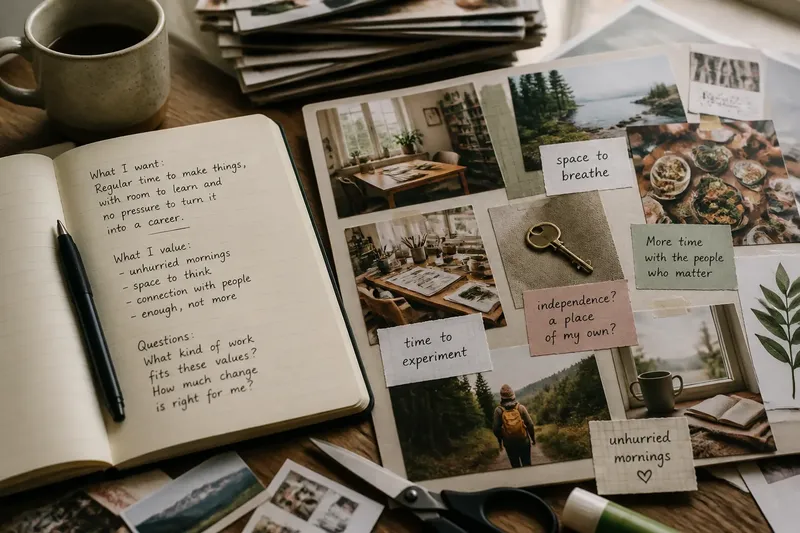
A vision board can bring mood, texture and association into view. A picture of a shared meal beside a note about flexible work might prompt you to ask whether the real subject is more time with other people, rather than a particular job title.
An image can mean different things to different people. A key might suggest privacy, independence or a place of your own. Add a caption if the intended meaning is not obvious to you when you look at the board later.
Images also carry messages from advertising and social media. A polished kitchen, admired title or scenic escape may represent someone else’s idea of success. Ask what the image stands for in your own life before giving it a place.
Compare the formats
Writing is suited to conditions, sequence and trade-offs. “I would like to change fields, provided I can learn while keeping a steady routine” puts an aspiration beside a constraint. A collage might show a classroom, a desk and a calendar, but it will not necessarily explain how they fit together.
Images can make an abstract quality easier to picture. Words might describe a calmer home; a photograph of soft light, open shelves and a chair near a window gives that phrase a setting to consider. The picture is not more accurate. It simply offers another way to examine the idea.
A written note is easy to revise privately. A board is easy to scan, but displaying it may feel exposing. Keep either format to yourself if that helps you think.
Combine words and images
Write a short description first. Then choose images that add something the words do not already say. A caption can record why each picture matters, while the arrangement can show which ideas seem connected or in tension.
Say you are considering more creative work but do not know whether that means a new role or a hobby. You write, “I want regular time to make things, with room to learn and no pressure to turn it into a career.” You cut out a picture of a cluttered worktable and add the caption “time to experiment”. Beside the sentence, the result makes clear that you value time to create, while leaving the career question open.
Choose an image because it raises a useful question, not only because it matches a finished ideal. If a picture of a studio appeals to you, ask whether you want solitude, a place to work, or simply the atmosphere in the photograph.
Which format fits my aim?
Should I write before making a board?
A few written lines can help if your images tend to look attractive but feel unclear. Note what you want more of, less of or still need to understand before choosing pictures.
Can a vision board include words?
Yes. Captions, questions and short phrases can explain why a picture belongs. Handwriting, printed text, drawings and photographs can sit together when each adds meaning.
What if I do not know what I want?
Write down what you notice rather than forcing a firm aim: “I miss making things with my hands” or “I want more unhurried time.” Use images to explore the mood or setting around those observations.
Should I share my vision board?
Share it if another person’s response would help you understand your choices. If you prefer privacy, keep it in a notebook or on a private digital canvas; the board does not need an audience.
Choose materials and decisions
Use a notebook and pen, a sheet of paper, scissors and old magazines, or a digital canvas. Leave some blank space for questions. As you assemble the page, check each element and decide what to do based on what you notice:
- If a sentence names only an activity, add the quality you hope it will bring; if you cannot name one yet, keep the activity as a question.
- If a phrase sounds like a firm decision but you are still unsure, add “perhaps” or “I wonder”; if you have decided, write the condition that matters to you.
- If an image has a personal association, add a caption naming it; if you cannot say what it means to you, leave it out for now.
- If a picture looks appealing because it is polished, ask what it represents in your life; if no personal meaning comes to mind, choose another image or leave the space blank.
- If two images seem connected, place them together and write the link; if the connection is unclear, keep them apart and add a question.
- If the page feels crowded, remove decoration that adds no meaning; if an idea still needs room, leave space beside it rather than squeezing in another picture.
- If the board would feel exposing to share, keep it private; if feedback would help, show it to someone you trust and explain what kind of response you want.
Read your sentence beside the board. If the pictures point somewhere different, note the mismatch before changing anything. It may reveal that the sentence is too broad, that an image carries an unexpected association, or that you are holding more than one possibility.
Questions to revisit
When should I revise the page?
Revise it when the words or pictures no longer help you think. Replace an image, add a note or keep it as a record of how your ideas have shifted.
Should I keep an older version?
Keep one if seeing earlier choices would help you understand what has changed. Treat it as a record of what you could express at the time, not as a prediction to judge later.
What if the words and images disagree?
Write down what each suggests before deciding which to change. The difference may point to a missing condition, an image with an unintended meaning, or two aims that need separate space.
When a picture catches your eye, write down the meaning you give it. That note can make the image easier to read later, even if the words you choose for your future change.