A Scenario Is a Question, Not a Forecast
Use a scenario to explore a possible change, clarify what matters in ordinary life and decide what information to seek before committing to a path.
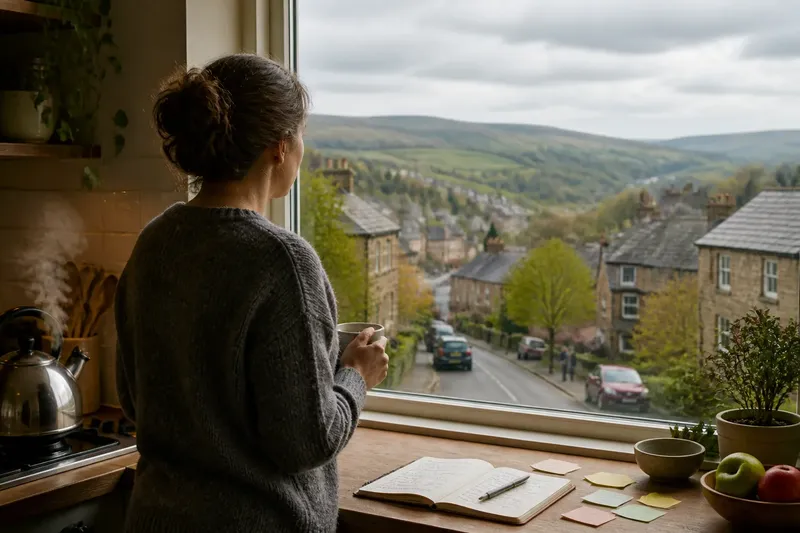
You are standing at the kitchen counter, weighing a move to a smaller town while the kettle boils. One picture shows an easier pace; another shows a longer journey to work. A scenario is a question, not a forecast: it gives you a way to examine how a possible change might affect daily life without claiming to know what will happen.
For personal planning, a scenario is a brief account of one possible set of circumstances and their practical consequences. It is not a prediction or a promise. Its purpose is to make the details of a choice easier to inspect: the routine it would create, the values it might support, and the parts that remain unknown.
Scenarios in planning
A scenario becomes useful when it describes ordinary life rather than a dramatic outcome. For the town move, that might mean describing where you would work, how you would get there, where you would buy food and what you would do on a quiet evening. These details expose the choices hidden inside a broad idea such as “a simpler life”.
Keep each account tied to a different condition or priority. If one version assumes remote work and another assumes a daily office commute, make that difference explicit. If several things change at once, it becomes difficult to tell which one is shaping your reaction.
Write what each possibility asks of you, not only what it offers.
Three scenario lenses
Best and difficult conditions
Set a hopeful but plausible version beside a challenging one. In the hopeful version, the commute is manageable and you find a regular local activity. In the difficult version, work travel takes more effort and social connections develop slowly. Neither version says which outcome is more likely.
This lens can help when enthusiasm or worry is dominating your picture. Ask what would need to be true for the hopeful version to work, and what resources would make the difficult one manageable. Treat the answers as conditions to examine, not reasons to force a decision.
Competing priorities
Describe versions organised around different values. One might protect time with family; another might leave room for career exploration; a third might make rest easier to prioritise. The location and basic circumstances can stay the same while the meaning of a good week changes.
This lens is useful when no option serves every priority. Name the cost as clearly as the benefit. A choice might offer quieter evenings while making visits to friends less spontaneous.
One changed condition
Hold most details steady and vary one factor that could alter the experience. For example, compare the town move with remote work against the same move with regular office travel. The difference can show whether your response depends chiefly on the work arrangement or on the town itself.
Use this lens when one unknown detail carries much of the weight. You may be able to ask an employer about schedules, map a route or visit the area. Checking a detail will not settle every question, but it can replace a guess with more grounded information.
Choosing a useful lens
Start with the kind of uncertainty you have. If you are swinging between excitement and fear, compare hopeful and difficult conditions. If two options support different values, write a version for each priority. If one practical detail seems decisive, vary that condition while keeping the rest of the situation stable.
Say you are considering a job that involves a longer commute. Your starting point is the same role and salary, but the schedule is unclear. First, write one version in which you can travel outside busy periods; then write another in which you must travel at the usual peak. Next, describe an ordinary workday in each, including when you leave home and what happens to your evening. You notice that the work itself appeals to you, but the peak journey would remove time you value for cooking and seeing a friend. The resulting question is whether the employer allows flexible hours. That answer would clarify a real trade-off; it would not decide the job for you.
Keep both descriptions similar in detail. Otherwise, the more vivid account may seem more convincing simply because you have imagined it more fully.
What should a scenario include?
How many scenarios are useful?
Two can reveal a meaningful contrast. Add another only if the first pair leaves out a genuinely different priority or condition. Stop when a new version repeats the same concern without adding a useful distinction.
How realistic should a scenario be?
Make it possible enough to examine, while keeping its uncertain parts visible. Possibility is not the same as likelihood. If a version depends on several things going well, name those conditions rather than writing as if they were settled.
What if I cannot resolve the uncertainty?
Separate known details from assumptions, then ask which unknown matters most to the choice. Some questions can be explored through a conversation, observation or reversible trial; others may remain open. The aim is to understand the uncertainty, not to erase it.
Should I choose the most appealing scenario?
No. A scenario is not an option you can select from a menu. Compare what each version would require, what it might support and which unanswered question could change your view.
Checking the assumptions
Turn a confident claim into a question you can investigate. “I will feel isolated there” could become “Which local activities fit the way I like to meet people?” “The journey will be exhausting” could become “What would the route involve on a day I need to be in the office?” A specific question makes it easier to choose a useful next action.
Use this short review before acting:
Work arrangement: Check whether the role requires office attendance. If the schedule is confirmed, include it in the scenario; if it is unclear, ask the employer before treating remote work as part of the plan.
Travel route: Check the route and the times you would need to travel. If the journey includes a workable connection, keep it as a possible routine; if it involves a difficult transfer, compare another route or reconsider the commute assumption.
Local routine: Check whether the places you rely on, such as a food shop or community space, are accessible to you. If they fit your routine, include them; if not, identify an alternative or mark the need as unresolved.
Social contact: Check which ways of seeing people matter to you. If regular visits are practical, include them in the imagined week; if travel makes them harder, consider a different visit pattern or treat reduced spontaneity as a real cost.
Time for rest: Check what the workday and household tasks leave you. If the routine protects time to recover, note that as a benefit; if it crowds out rest, change a condition or recognise the trade-off before proceeding.
Open assumption: Check which belief has no information behind it yet. If you can ask someone or observe the situation, choose that action; if you cannot, label the point uncertain and decide whether that uncertainty is acceptable.
Say you are considering the smaller town and have three starting details: your employer has not confirmed a remote-work arrangement, a friend lives nearby, and you usually prefer meeting people through shared activities. First, keep the town and your current work unchanged while writing one version with remote work and one with regular office travel. Then note that the work arrangement is unknown, rather than assuming either version is true. Next, look for a local activity that matches your interests and ask your friend what visiting would involve. The result is a clearer trade-off: the friend offers a possible source of contact, while the work schedule and local routine still need checking. You can now decide whether to seek those answers before considering a move, or whether the unresolved points make the choice feel premature.
From story to enquiry
Choose an action that addresses one assumption at a time. You might travel the route at the relevant time, spend an ordinary afternoon in the town or ask a prospective manager about scheduling. Beforehand, write down what you will observe, such as the transfers involved or whether the work hours are flexible. An ordinary visit cannot reproduce the whole experience of living somewhere, but it can answer a narrower question.
When you return to your scenarios, revise only the details that new information actually changes. A conversation may clarify the schedule; a visit may help you understand how far familiar places feel from the centre. Neither tells you exactly how you will feel later. Each gives you a better-grounded account of the choice.
Keeping scenarios provisional
Written possibilities can start to sound like facts. Mark assumptions clearly, and update them when you learn something relevant. Use “if this were true” when a version begins to feel certain. The phrase reminds you that the story is a tool for examining conditions, not evidence about what lies ahead.
A scenario remains useful even when it leaves a question unanswered. It can show which parts of a possible change fit your values, which depend on practical arrangements and which you may have to accept as uncertain. For personal planning, that distinction can help you choose what to ask next—or recognise when there is not yet enough information to make a settled choice.